SEO
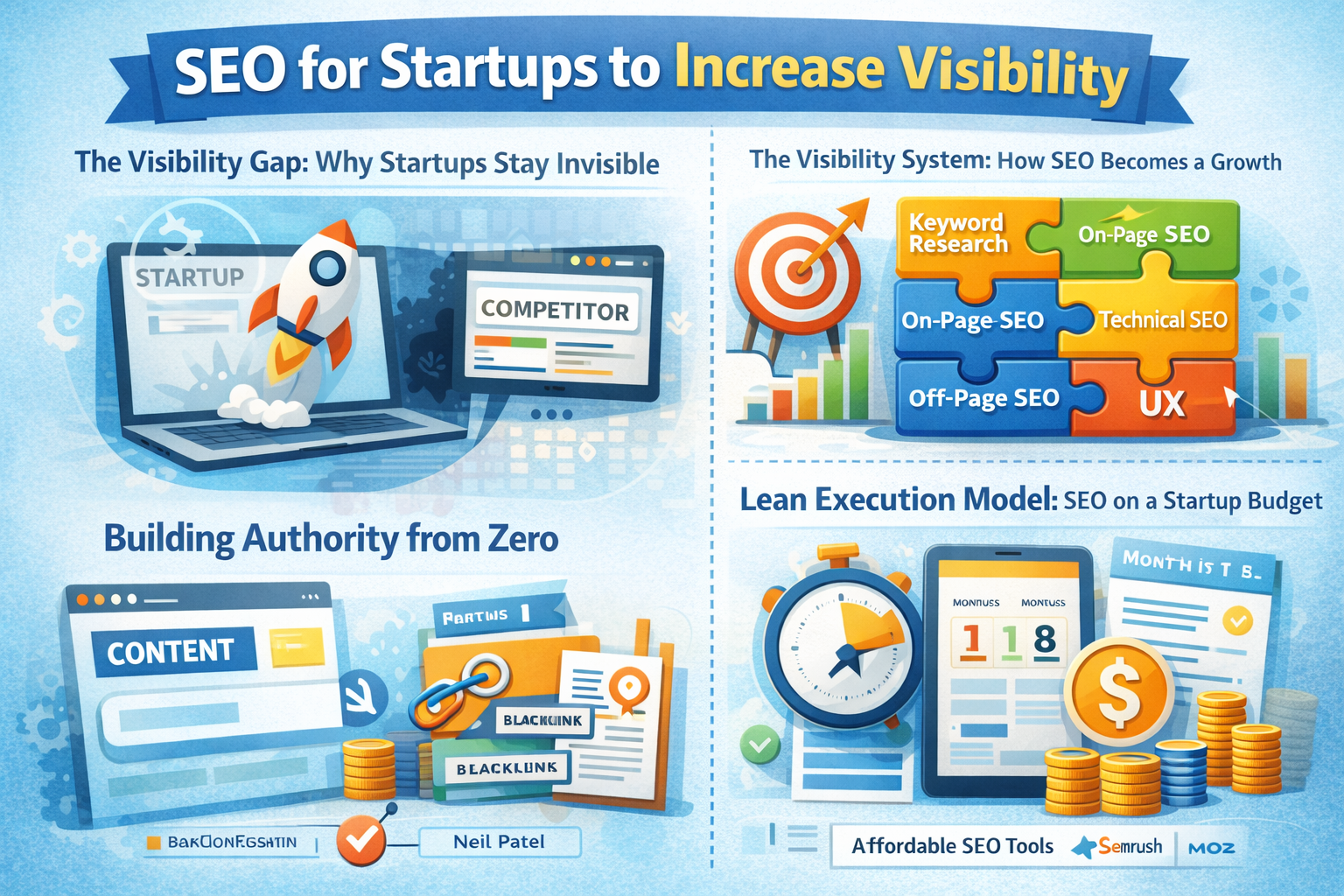
The Visibility Gap: Why Startups Stay Invisible
Writing Style Selected: Problem-Focused + Analytical Style (Purpose: Identify the core issue and build urgency without hype.)
Most startups do not fail because of bad products. They fail because no one finds them.
That is the real visibility gap.
When a new company launches, it has:
- No brand authority
- No backlinks
- No search rankings
- No search visibility
At the same time, large competitors dominate the SERP. They have years of content, strong domain authority, and deep marketing budgets.
For early-stage companies, this creates a hard reality. Paid ads can bring traffic, but they drain a small startup marketing budget quickly. Once ads stop, traffic disappears.
This is why SEO for startups to increase visibility is not optional. It becomes a core part of startup digital marketing.Startups often operate with limited marketing budgets. Premium SEO platforms can be expensive in the early stages. Many founders look for cost-effective solutions such as group buy SEO tools to access multiple SEO tools at a lower cost while building their startup SEO strategy.
In competitive ecosystems like Silicon Valley and San Francisco, startups compete for investor attention after Startup Funding. Growth metrics matter. Organic traffic matters. Search presence matters.
Without Search Engine Optimization, a startup website is invisible to people actively searching for solutions.
The visibility gap exists because:
- No structured startup SEO strategy
- Weak keyword research
- Poor On-Page SEO
- No Off-Page SEO
- Technical SEO ignored
- No content marketing plan
Search engines rely on Crawling and Indexing to discover pages. If your site structure is weak, your pages may not even enter the index properly.
Visibility starts with structure.
That structure becomes your startup SEO foundation.
The Visibility System: How SEO Becomes a Growth Engine
Writing Style Selected: Educational + Systems Thinking Style (Purpose: Explain SEO as a structured system, not random tactics.)
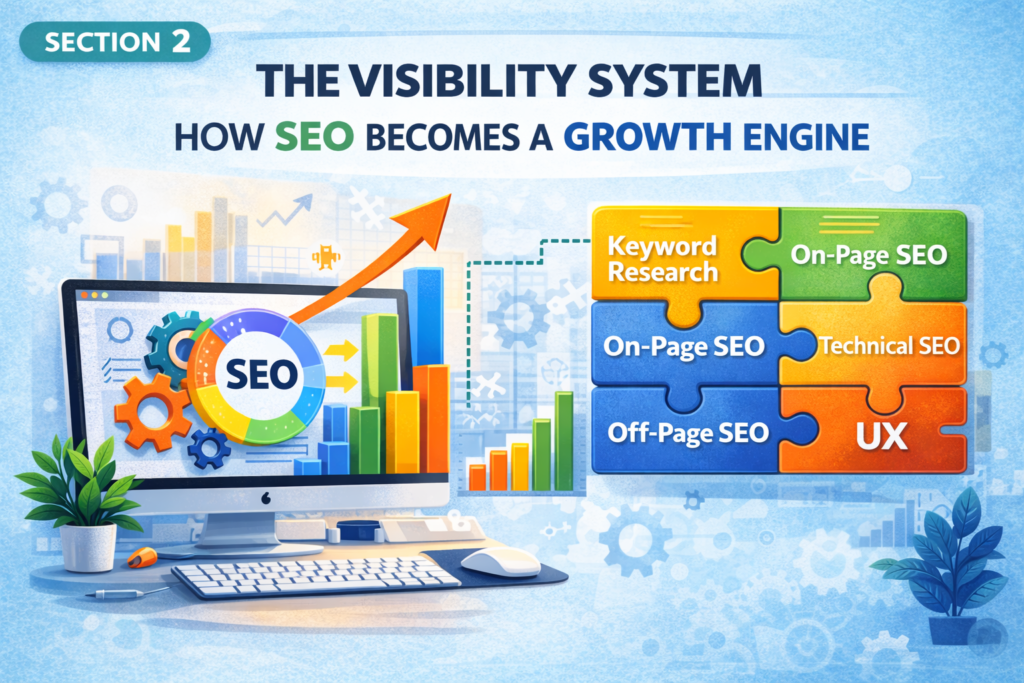
SEO works when treated as a system.
Many founders think search engine optimization is about adding keywords to pages. It is not. It is about aligning your website with how search engines rank content.
A proper startup SEO strategy connects five pillars:
- Keyword Research
- On-Page SEO
- Technical SEO
- Off-Page SEO
- User Experience (UX)
Each pillar supports startup visibility increase.
1. Keyword Research as Market Research
Startup keyword research is not just traffic hunting. It reveals what customers are already searching for.
Using tools like Ahrefs, SEMrush, and Moz, startups can:
- Identify long-tail keywords
- Study SEO competitive analysis
- Understand search intent
- Discover low-competition entry points
This supports early stage SEO and improves SEO ranking for startups.
2. On-Page SEO Aligns Pages With Search Intent
On-page SEO includes:
- Title tags
- Meta descriptions
- Structured headings
- Internal linking
- Content optimization
This improves how pages appear in the SERP and supports SEO website optimization.
3. Technical SEO Enables Crawling and Indexing
Search engines must access your content.
Technical SEO ensures:
- Clean site architecture
- XML sitemap
- HTTPS security
- Fast page speed
- Mobile-first indexing
Google Search Console helps monitor crawl errors and indexing status. Without technical SEO, search visibility weakens.
4. Off-Page SEO Builds Authority
Backlinks remain a major SEO ranking factor.
Startup link building includes:
- Guest posting
- Digital PR
- Partnerships
- Resource link outreach
Quality backlinks improve domain authority and increase organic traffic.
5. User Experience Supports Rankings
User Experience (UX) affects dwell time and bounce rate. Mobile SEO and speed optimization improve engagement. That supports SEO visibility for startups.
When these five pillars work together, SEO becomes a growth engine instead of a guessing game.
Building Authority from Zero: Trust, Content, and Backlinks
Writing Style Selected: Advisory + Practical Strategy Style (Purpose: Show how startups build trust step-by-step.)
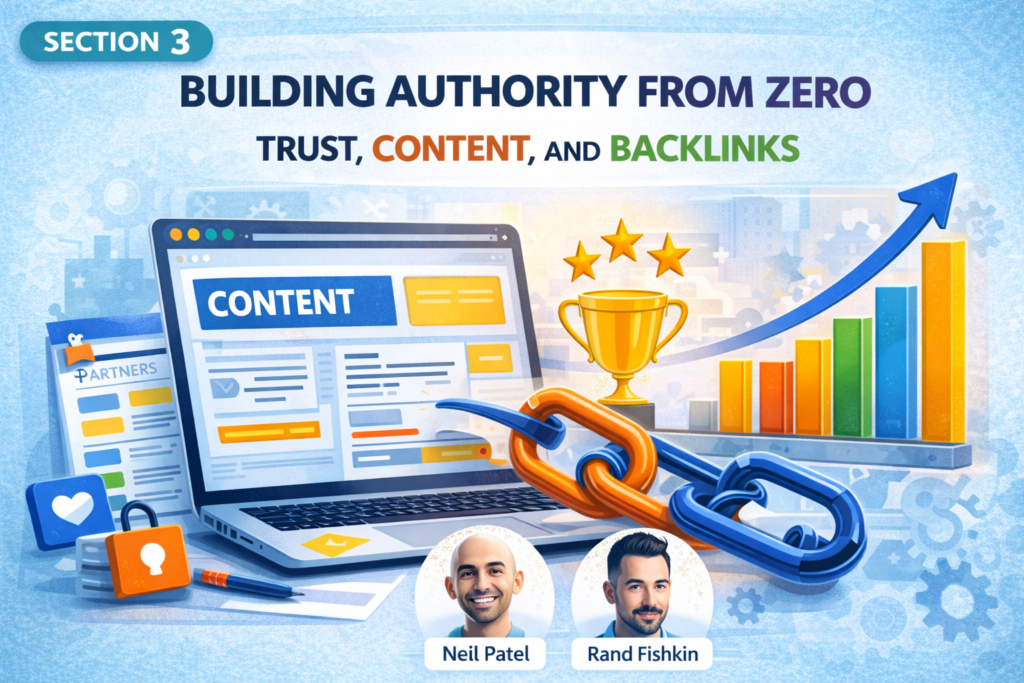
New startups start with zero authority.
Search engines trust websites that show expertise, consistency, and references from other sites.
Authority grows through three areas:
1. Content Marketing With Intent
SEO content marketing should answer real search queries.
A strong startup content marketing approach includes:
- Educational guides
- Problem-solution blog posts
- Commercial landing pages
- Comparison pages
Brian Dean popularized the skyscraper method: find high-ranking content and improve it with better depth and structure.
This improves SERP rankings and supports SEO increase web traffic.
2. Structured Content Optimization
Content optimization means:
- Updating old pages
- Improving internal linking
- Aligning content with keyword research
- Improving clarity
Strong content supports Conversion Rate Optimization (CRO). Traffic must convert into leads.
3. Backlink Building for Authority
Backlink building signals credibility.
Neil Patel and Rand Fishkin both emphasize quality over quantity. A few strong backlinks outperform many weak ones.
Startup link building strategies include:
- Niche guest articles
- Data-driven research posts
- Founder interviews
- Industry directories
Backlinks improve domain strength and support long-term SEO visibility.
Authority building takes time. But once built, it compounds.
Lean Execution Model: SEO on a Startup Budget
Writing Style Selected: Founder-Focused + Tactical Style (Purpose: Show how to execute with limited resources.)
Startups do not have enterprise budgets.
A lean startup SEO checklist focuses on high-impact actions.
Phase 1: Foundation (Month 1–2)
- Complete SEO technical audit
- Run full website audit
- Fix indexing issues
- Set up Google Analytics
- Set up Google Search Console
This ensures measurement and crawl health.
Phase 2: Content Expansion (Month 2–4)
- Target low-competition long-tail keywords
- Publish structured content weekly
- Optimize internal linking
- Improve on-page SEO
This supports SEO traffic generation.
Phase 3: Authority Growth (Month 4–8)
- Begin startup link building
- Pitch guest content
- Build partnerships
- Improve domain authority
This strengthens SEO ranking factors.
Affordable SEO Tools for Startups
Many startups use:
- Ahrefs
- SEMrush
- Moz
These startup SEO tools support keyword research, backlink analysis, and SEO competitive analysis.
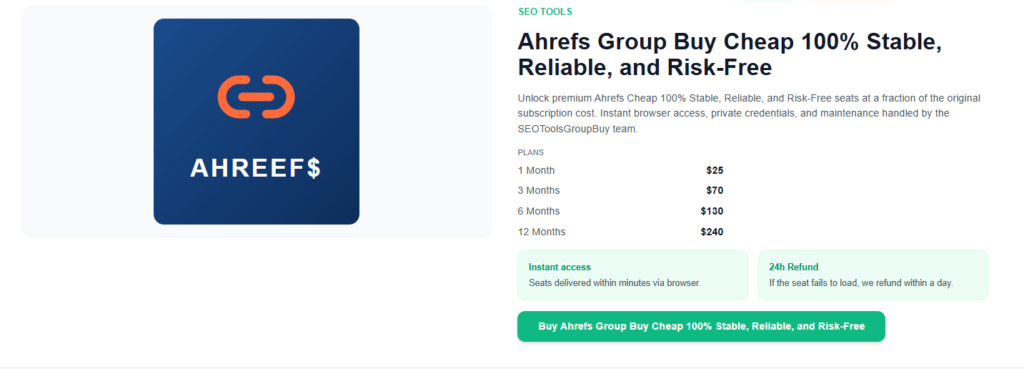
Many early-stage teams rely on tools like Ahrefs group buy to conduct keyword research and SEO competitive analysis without stretching their startup marketing budget.
Lean execution means prioritizing actions that increase business visibility without overspending.
Tracking, Optimization, and Scaling SEO
Writing Style Selected: Analytical + Growth-Oriented Style (Purpose: Focus on measurement, scaling, and investor relevance.)
SEO must be measurable.
Without analytics tracking, growth becomes guesswork.
Measuring Visibility Growth
Use Google Analytics to track:
- Organic traffic growth
- Conversion rates
- User behavior
Use Google Search Console to track:
- Impressions
- Clicks
- Keyword rankings
- Index coverage
This shows real SEO visibility progress.
Proving SEO ROI
Investors care about outcomes.
To prove SEO ROI:
- Show traffic vs revenue correlation
- Measure CAC reduction
- Track lead growth
For startups after funding rounds, this data builds confidence.
Scaling With Artificial Intelligence (AI) in SEO
Artificial Intelligence (AI) in SEO supports:
- Keyword clustering
- Content automation
- SEO growth hacking
- Faster competitive analysis
AI helps startups scale content without increasing headcount.
SEO becomes part of long-term startup digital marketing strategy.
Conclusion: Turning Search Into a Long-Term Asset
Writing Style Selected: Clear Strategic Wrap-Up Style
SEO for startups to increase visibility is not a shortcut. It is a structured growth model.
A startup SEO strategy combines:
- Keyword research
- On-page SEO
- Technical SEO
- Off-page SEO
- Content marketing
- Link building
- Analytics tracking
When executed consistently, organic traffic becomes predictable.
Search engine optimization turns your website into a permanent acquisition channel.
For startups competing in crowded markets, visibility is leverage.
Optimize this article for ranking + conversions before publishing.
I’ll give you a practical publishing checklist for your site.
STEP 1: SEO Optimization Before Publishing
1️⃣ Optimized Meta Title (CTR Focused)
SEO for Startups to Increase Visibility (Proven Growth Framework)
Alternative (higher click intent): SEO for Startups to Increase Visibility: A Practical Growth Guide
2️⃣ Meta Description (150–160 characters)
Increase startup visibility with a structured SEO strategy. Learn keyword research, link building, technical SEO, and traffic growth systems.
3️⃣ URL Structure
Use:
/seo-for-startups-to-increase-visibility/
Keep it clean. No extra words.
STEP 2: Internal Linking Strategy
To improve SEO ranking faster, add internal links like this:
- From homepage → link to this article using anchor: SEO for startups
- From any “startup marketing” article → link using anchor: startup SEO strategy
- From any “keyword research” article → link using anchor: startup keyword research
Internal linking improves:
- Crawling and Indexing
- Page authority flow
- SERP positioning
STEP 3: Add Strategic Backlink Placement (Your Site)
Since your site is about group buy SEO tools, place contextual links like this:
Inside Keyword Research section:
Startups often use tools like Ahrefs for competitive analysis. Affordable access options such as Ahrefs for startup keyword research can help reduce tool costs while building a strong SEO foundation.
Link: https://seotoolsgroupbuy.us/ahrefs
Keep it natural. Only 1–2 placements max.
STEP 4: Schema Markup (Important for SERP Boost)
Add:
- Article Schema
- FAQ Schema (add 3–4 FAQs at bottom)
Example FAQs to add:
- What is SEO for startups?
- How long does startup SEO take?
- Is SEO better than paid ads for startups?
- What tools do startups need for SEO?
FAQ schema increases rich results visibility.
STEP 5: Add 3 Conversion Elements
To convert traffic into buyers:
- Add a small CTA after Section 2 Example: “Need affordable SEO tools to implement this strategy? Explore premium tools at startup-friendly pricing.”
- Add comparison table (Ahrefs vs SEMrush vs Moz)
- Add tool recommendation box after keyword research section
STEP 6: Image Optimization
For the images you generated:
- Compress images
- Add ALT text like:
- “SEO for startups to increase visibility infographic”
- “How search engine optimization works for startups”
- Add descriptive file names
This improves image SEO.
STEP 7: Topical Authority Boost (Very Important)
Now build 5 supporting articles and interlink them:
- Startup Keyword Research Guide
- Technical SEO for Early-Stage Startups
- Link Building for Startup Growth
- SEO Tools for Startups (Budget Version)
- Startup SEO Checklist (Downloadable)
This creates a content cluster. Google sees topical depth.
STEP 8: Publishing Checklist
Before hitting publish:
- H1 used once
- Keyword appears naturally (not stuffed)
- Internal links added
- 1–2 outbound authority links
- Mobile friendly
- Fast loading
- Google Search Console URL submitted
About the Author