SEO API
SEO depends on data.
You track keyword rankings. You monitor backlinks. You analyze search results. Then you build reports and adjust your strategy.
The problem is simple. Manual data collection takes time.
An SEO API allows you to automate that work.
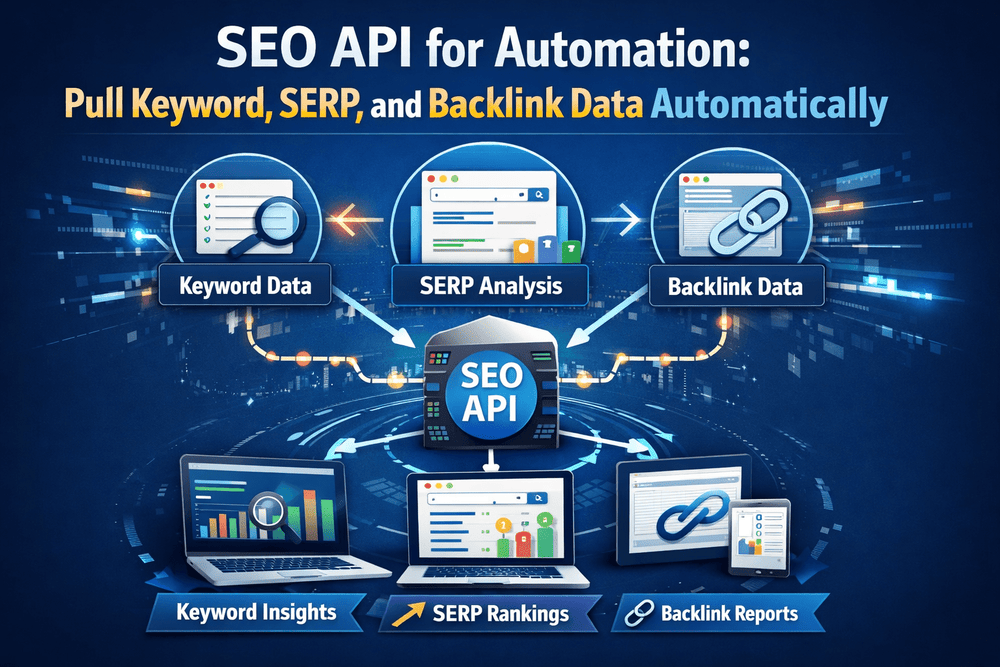
Instead of exporting reports from multiple tools, your system pulls SEO data automatically. Keyword rankings, SERP results, and backlink metrics update in real time.
Automation helps SEO teams scale their work without increasing manual tasks.
According to BrightEdge (2024), organic search generates more than 53 percent of total website traffic. Access to accurate and up-to-date SEO data helps teams capture that traffic.
This guide explains how SEO APIs automate data collection and improve SEO workflows.
Understanding SEO API Automation
An SEO API allows applications to request SEO data directly from SEO platforms.
Your system sends a request. The API returns structured data such as keyword rankings or backlink profiles.
You can automate the collection of:
- keyword search volume
- ranking positions
- SERP features
- backlink metrics
- competitor keyword data
This data can update automatically on a schedule.
Instead of manually exporting reports, your dashboards refresh automatically.
Rand Fishkin, co-founder of SparkToro, highlights the importance of data-driven SEO:
“Modern SEO depends on understanding search behavior through reliable data.”
Automation helps teams collect that data consistently.
Key SEO Data You Can Automate
Automation works best when you focus on the most valuable datasets.
Keyword Data
Keyword APIs provide the core metrics used in SEO planning.
These include:
- monthly search volume
- keyword difficulty
- keyword trends
- related keyword suggestions
You can collect large keyword datasets and analyze them at scale.
SERP Data
SERP APIs show what appears on search engine results pages.
This information helps you understand the real competition behind a keyword.
Common SERP data includes:
- top ranking pages
- featured snippets
- People Also Ask questions
- video or image results
SERP analysis reveals search intent and content opportunities.
Backlink Data
Backlink APIs track links pointing to your website or competitors.
You can monitor:
- referring domains
- anchor text
- domain authority
- new backlinks
These metrics help you measure link-building campaigns.
Practical SEO Automation Workflows
SEO automation usually follows a structured process.
First, connect an SEO API provider to your system.
Second, configure scripts that request keyword, SERP, or backlink data.
Third, store the collected data in a database.
Finally, display the results in dashboards or automated reports.
This workflow allows teams to monitor SEO performance continuously.
For example, a script may collect keyword rankings daily and update a dashboard that tracks ranking changes.
Popular SEO APIs Used for Automation
Several platforms provide SEO APIs that support automation.
Examples include:
- Ahrefs API
- SEMrush API
- DataForSEO
- SerpAPI
- Moz API
Each platform offers different types of SEO data.
Some specialize in backlink indexes. Others focus on SERP data or keyword metrics.
Choose the provider that matches your SEO goals.
Benefits of Automating SEO Data Collection
Automation changes how SEO teams work.
Faster Data Access
Automation collects large datasets quickly. You avoid repetitive manual exports.
Scalable SEO Operations
Automation supports projects that involve thousands of keywords or multiple websites.
Real-Time Insights
Automated systems collect data regularly. Your reports stay updated with the latest search changes.
According to HubSpot’s 2025 marketing automation report, marketing teams using automation improve productivity by more than 20 percent.
SEO teams experience similar efficiency gains.
When You Should Use an SEO API
Not every SEO project requires automation.
However, APIs become valuable when you:
- manage many websites
- analyze large keyword datasets
- monitor competitor backlinks
- build custom SEO dashboards
- develop SEO software tools
Automation becomes essential as SEO operations scale.
About the Author