
La Liga
Penalty kicks in La Liga 2022/23 clustered heavily around a handful of teams rather than being evenly scattered, and those imbalances were rooted in tactical choices, defensive pressure, and risk tolerance. Understanding which sides repeatedly drew contact in the box and which sides repeatedly committed last-ditch fouls is essential if you want to treat penalties as structural features of a team’s profile instead of random one-off moments.
Why Penalty Trends Matter More Than Isolated Incidents
Penalties radically change the scoring expectation of a match because they convert at a far higher rate than open-play chances, so teams that regularly reach double digits in penalties for have an embedded boost to their goal difference across a season. At the same time, teams that frequently concede spot-kicks carry a hidden tax on their defensive record, often turning otherwise even games into defeats once a single clumsy challenge or poorly timed tackle is punished. The 2022/23 La Liga campaign illustrated how these patterns build over 38 games, turning tactical tendencies in and around the area into measurable advantages or liabilities that appear in standings, goal totals, and perceived team strength.
Teams That Won Penalties Most Often in 2022/23
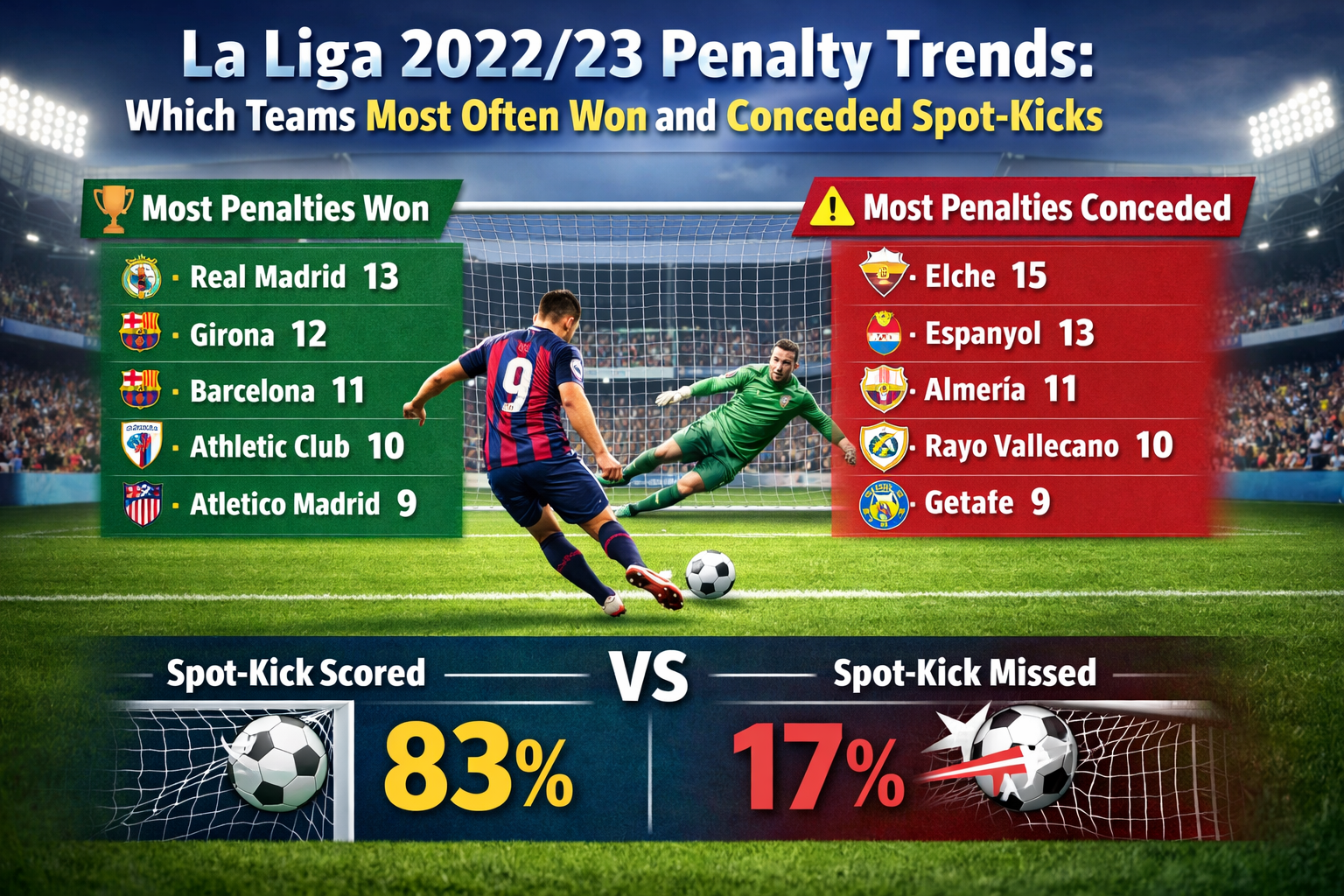
When you rank La Liga 2022/23 clubs by penalties awarded, Real Madrid sit clearly at the top with 13 spot-kicks, ahead of a second tier of Girona and Real Betis on 9, then a broader group including Valencia, Getafe and Rayo Vallecano on 8. That list underlines how frequent box entries and dribbling in tight spaces draw fouls: Madrid’s sustained territorial dominance and one‑v‑one threats contrasted with Girona and Betis using combination play and late runs to provoke contact, while Valencia and Getafe leaned more on direct balls and duels. Even Barcelona’s unusually low tally of just 2 league penalties despite high scoring emphasised that volume of goals alone does not guarantee penalties; the shape of chance creation, referee perception and how often players carry the ball through traffic matter just as much.
Teams That Struggled to Win Penalties
At the other end of the table for penalties awarded, Atlético Madrid earned only 1 spot-kick in the entire league season, while sides such as Celta Vigo, Almería and Real Sociedad finished with tiny totals compared with Madrid or Girona. That pattern reflects more than bad luck: Atlético’s more cross‑heavy or transition‑based approach, with fewer extended sequences inside congested areas, simply offered fewer situations where defenders had to defend facing their own goal and risk trips or handballs. For teams like Celta or Almería, limited sustained pressure in the opposition box meant they relied far more on open-play finishing, so any short cold spell in front of goal hurt them more because they lacked the “safety valve” of regular penalties to top up scoring.
Who Conceded Penalties Most Frequently and Why It Happened
A separate ranking of penalties conceded shows a different group of teams repeatedly putting themselves in bad situations, with relegation candidates and mid-table strugglers disproportionately represented. Sides that defended deep but without clean footwork or coordination often resorted to desperate blocks, pulls or mistimed tackles as opponents broke lines in the area, producing a cluster of spot-kicks against even if their overall shot volume allowed was not extreme. For these teams, the combination of low attacking firepower and a high rate of penalties conceded created fragile game states where a single incident swung matches away from them, compressing their margin for error across the season.
Penalty Conversion, Misses and Psychological Impact
The raw count of penalties tells only part of the story because missed spot-kicks and saves can subtly change how both teams behave in later matches. Transfermarkt’s breakdown of missed penalties highlights that several prominent clubs, including Real Madrid and Athletic, had key takers fail from the spot, reminding us that even structurally penalty‑rich sides can leak value if their execution is inconsistent. On the defensive side, once a team concedes several penalties in quick succession, defenders often become overly cautious in the box, which can paradoxically encourage opponents to attack those zones more often, reinforcing a cycle where penalty risk becomes a psychological factor rather than just a statistical one.
How Penalty Profiles Feed Data-Driven Betting
From a data-driven betting perspective, penalty frequency needs to be treated as a separate variable rather than lumped in with general attacking or defensive metrics, because a side that generates average shot volume but very high penalty counts has a different scoring profile from a team that relies mostly on low‑probability efforts. The long‑run gap between Real Madrid’s penalty count and Barcelona’s in recent seasons shows how spot-kicks can tilt expected goals and final scores without necessarily matching overall offensive production, so properly weighting penalty reliance is crucial when estimating true goal expectation. For bettors building models around xG or goal lines, ignoring the repeatable element of penalty trends risks underpricing teams whose attacking patterns systematically expose rash defenders, or overvaluing those whose recent tallies are inflated by a handful of rare decisions unlikely to repeat.
Mechanisms Linking Penalties to Over/Under and Handicap Lines
The mechanism connecting penalty patterns to totals and handicaps works through both conversion rate and match timing: an early spot-kick raises the chance of a more open game, while a late one can salvage an underdog or sink a favourite, depending on game state. In leagues and seasons where penalties arrive in bunches for a few teams, bookmakers adjust by shading lines upward or tightening handicaps for those sides, but that process is rarely perfect across all fixtures. Data-driven bettors benefit when they distinguish clubs whose penalty numbers match multi‑season tactical patterns from those whose current season is a spike, allowing them to lean into stable profiles and fade short-term noise.
Situational Use of UFABET Within a Structured Approach
When someone applies this type of structured analysis in a real betting context, the practical challenge is to embed penalty data into a broader framework that already accounts for xG, game state tendencies and scheduling rather than chasing any single statistic in isolation. In scenarios where a bettor accesses odds through ufabet168, the value comes not from the name on the screen but from how carefully they compare that site’s prices on goal lines, team totals or player penalties with their own projections that explicitly factor in which La Liga sides move the needle most through spot-kicks. Treating penalties as a separate column in the evaluation process, rather than a narrative afterthought, helps prevent overreaction to a single contentious decision and encourages a disciplined focus on whether the posted lines properly reflect long‑term tendencies for specific teams to win or concede penalties.
Penalty Trends and casino online Environments
Because penalty frequency directly affects goal distribution and the volatility of match outcomes, it also shapes how different markets inside an online football betting environment behave, from main match odds to derivatives tied to goals and incidents. In a situation where a bettor is comparing offerings in a casino online context that includes integrated sports wagering, the most informed approach is to treat any boost offers or specials on penalty-related markets as hypotheses about how often certain La Liga teams will reach the spot, then weigh those assumptions against historical numbers such as Madrid’s 13 awards or Barcelona’s unusually low tally in 2022/23. When those internal prices materially overshoot what the underlying data suggest, either by exaggerating a recent run of decisions or ignoring a multi-season pattern, disciplined users can selectively engage with or pass on these options rather than letting interface design or promotional framing dictate their exposure.
Summary
La Liga 2022/23 confirmed that penalties are not evenly distributed accidents but repeatable outcomes concentrated among teams whose attacking patterns and defensive behaviours constantly test decision-making inside the box. Real Madrid’s 13 penalties won, compared with single‑digit figures for most rivals and just 2 for Barcelona, underlined how spot-kicks can create a persistent scoring edge that is not fully captured by overall goal totals alone. At the same time, the teams that conceded penalties most frequently paid a heavy cost in tight matches, turning structural defensive weaknesses into points dropped and league positions lost over the season. For analysts and bettors working with data-driven methods, the lesson from 2022/23 is that penalty trends must be modelled explicitly—both for and against—if you want a realistic view of true team strength, risk and value in La Liga markets.
About the Author